


If you’ve ever observed bees, you might have noticed that they are most active during the day and seem to disappear at night. But can bees fly at night? While some insects, like moths and fireflies, thrive in the dark, most bees are diurnal and struggle to navigate without sunlight. However, there are exceptions—some bee species have adapted to flying in low-light conditions. In this article, we’ll explore why bees can’t fly at night under normal circumstances, which species defy this rule, and how artificial lights can sometimes disrupt their natural behavior.
How Bee Vision Affects Their Ability to Fly at Night
One of the main reasons why bees struggle to fly in darkness is their unique vision. Unlike humans, bees have two types of eyes:
- Compound Eyes – These large eyes help bees detect movement and recognize patterns. However, they require bright light to function effectively.
- Ocelli (Simple Eyes) – These three small eyes help bees sense light intensity, but they don’t provide detailed vision in the dark.
Do Bees Have Night Vision?
While some insects, like moths, have excellent night vision, bees do not see at night as well as nocturnal creatures. Their eyes are adapted for daylight conditions, making it difficult for them to navigate after sunset. If you’re curious about their eye structure and how it impacts their ability to see, check out how many eyes does a bee have for a deeper understanding. This is a key reason why bees can’t fly at night or struggle to do so.
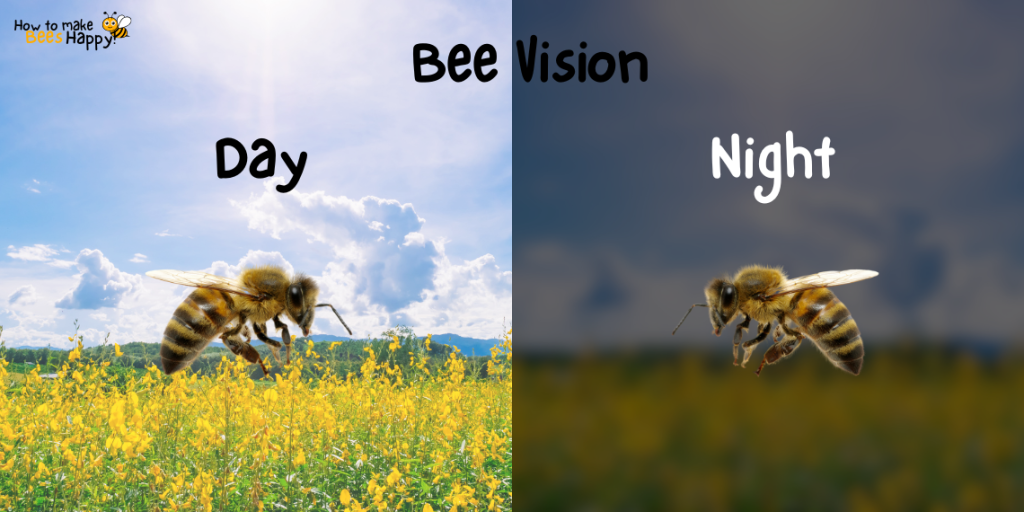
Do Bees Fly at Night?
In general, bees can’t fly at night because they rely on sunlight for orientation. Honey bees, for example, use the sun’s position to navigate and communicate with their hive members through the famous “waggle dance.”
Are Honey Bees Active at Night?
No, honey bees are not active at night unless disturbed. They return to the hive at dusk and remain inside until sunrise. However, some environmental factors might cause exceptions.
Do Honey Bees Fly at Night?
Under normal circumstances, honey bees do not fly at night. However, artificial lights near their hive can confuse them, causing them to venture out. Beekeepers sometimes notice bees out at night around streetlights or porch lights.
Why Don’t Bees Fly at Night?
There are several reasons why bees don’t fly at night:
- Poor Vision in Darkness – As mentioned earlier, bees do not have strong night vision.
- Lower Temperatures – Bees require warm muscles to fly efficiently, and nighttime temperatures are often too low.
- Increased Predator Threats – Nocturnal predators, such as bats and owls, pose a danger to bees at night.
- Navigation Issues – Since bees see at night poorly, they can easily get lost or fail to return to their hive.
This explains why bees can’t fly at night under normal conditions.
Are There Bees That Can Fly at Night?
While most bees are diurnal, some species have evolved to fly in low-light environments. These include:
- Indian Carpenter Bees (Xylocopa sp.) – These large bees have enhanced night vision, allowing them to forage after sunset.
- Megalopta (Sweat Bees) – These bees have highly sensitive ocelli, enabling them to navigate at dusk and dawn.
Do Bees Work at Night?
For honey bees, most tasks happen during the day. However, inside the hive, bees remain busy at night, cleaning cells, tending to larvae, and processing nectar. So while honey bees are not active at night outside, they do work internally.
Do Bees Go Away at Night?
Yes, as the sun sets, bees return to their hive. But where do they go exactly?
Where Do Bees Go at Night Time?
- Honey Bees – Remain inside the hive, clustered together for warmth.
- Solitary Bees – Seek shelter in burrows, wood crevices, or flowers.
- Bumblebees – Queens rest underground while workers sleep in the nest.
If you ever wonder, “Are bees awake at night?” the answer is yes, but they rest rather than fly.
Are Bees Attracted to Artificial Light at Night?
Although bees generally avoid darkness, artificial lights can disrupt their behavior. Some bees may become disoriented and bees out at night near porch lights or streetlights.
Bees and Light Pollution
Research suggests that increasing light pollution affects pollinators, including bees. Some scientists believe this interference could be harmful, disrupting natural behaviors.
Can Bees Fly at Night?
To summarize, bees do not usually fly at night because of poor night vision, colder temperatures, and the risk of predators. However, some nocturnal bee species, like Megalopta, have adapted to low-light conditions.
So, can bees fly at night? Most species cannot, but there are exceptions. If you see bees out at night, they are likely disoriented by artificial light.
Understanding bee behavior helps us protect these essential pollinators and appreciate their fascinating adaptations.